How Is a Life Path Number Calculated?
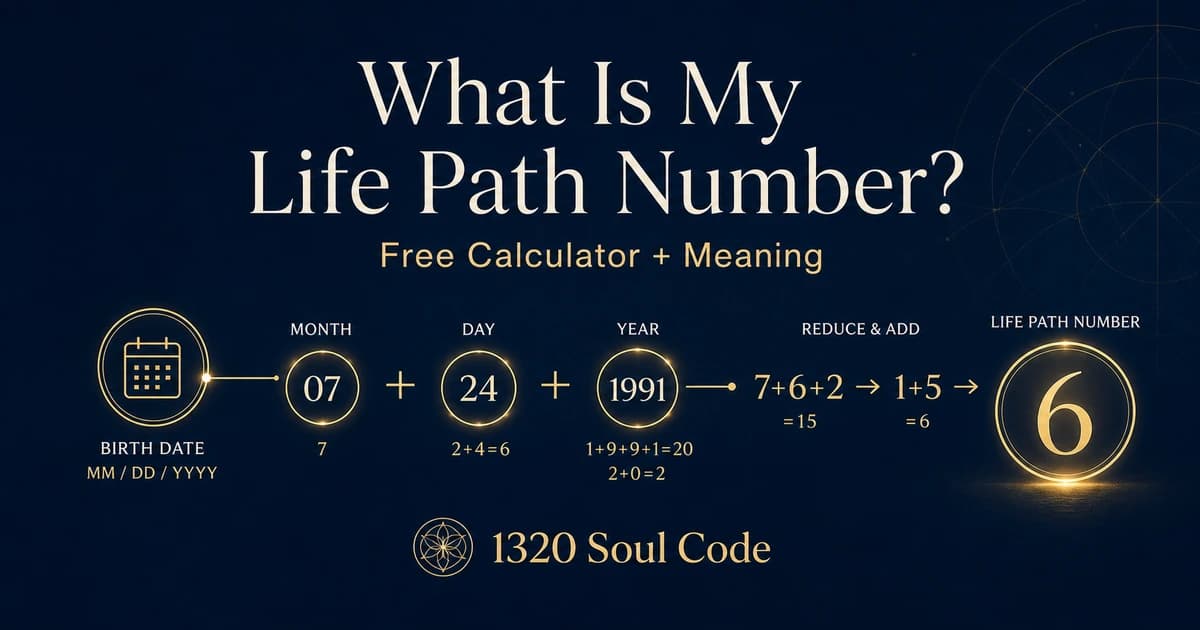
Birth date: 15 June 1990
- Month: June = 6
- Day: 15 → 1 + 5 = 6
- Year: 1990 → 1 + 9 + 9 + 0 = 19 → 1 + 9 = 10 → 1 + 0 = 1
- Combined total: 6 + 6 + 1 = 13
- Final reduction: 1 + 3 = 4
- Life Path Number: 4
This method keeps the month, day and year visible as separate parts of the calculation.
That transparency matters because some numerology methods preserve Master Numbers during intermediate stages, while other calculators add every birth-date digit in one line.
A different calculator may display a different compound calculation if it uses another reduction convention. The result should always show which method was used.
Life Path Number Meanings
The brief meanings below are commonly associated with each Life Path Number in numerology.
They are symbolic prompts for reflection—not fixed identities, diagnoses or predictions.
Life Path 1 · The Initiator
Life Path 1 is commonly associated with independence, initiative, originality and the willingness to begin. Its constructive expression may involve leadership, courage and self-direction. Its growth edge may involve isolation, impatience or feeling that everything must be carried alone.
Common strengths: Independence · Initiative · Originality · Courage
Possible growth edge: Allowing support without losing self-direction
Reflection: Where am I being invited to begin—and where could independence include support?
Life Path 2 · The Harmoniser
Life Path 2 is commonly associated with cooperation, sensitivity, patience and relational awareness. Its constructive expression may involve listening, mediation and recognising subtle dynamics. Its growth edge may involve self-silencing, indecision or over-adapting to preserve harmony.
Common strengths: Cooperation · Sensitivity · Patience · Relational awareness
Possible growth edge: Remaining connected without disappearing inside others’ needs
Reflection: How can I remain connected without disappearing inside the needs of others?
Life Path 3 · The Communicator
Life Path 3 is commonly associated with expression, imagination, creativity and communication. Its constructive expression may involve bringing ideas, feeling or beauty into visible form. Its growth edge may involve scattered focus, avoidance through performance or difficulty staying with uncomfortable emotions.
Common strengths: Expression · Imagination · Creativity · Communication
Possible growth edge: Giving ideas enough commitment to become real
Reflection: What wants to be expressed—and what deserves enough commitment to become real?
Life Path 4 · The Builder
Life Path 4 is commonly associated with structure, reliability, discipline and practical foundations. Its constructive expression may involve planning, stewardship and creating what can endure. Its growth edge may involve rigidity, overwork or using control to manage uncertainty.
Common strengths: Reliability · Discipline · Organisation · Persistence
Possible growth edge: Allowing flexibility without losing stability
Reflection: Where does structure support my life—and where has it become too tight?
Life Path 5 · The Explorer
Life Path 5 is commonly associated with freedom, movement, adaptability and experience. Its constructive expression may involve curiosity, versatility and openness to change. Its growth edge may involve restlessness, impulsivity or leaving before an experience has had time to deepen.
Common strengths: Freedom · Adaptability · Curiosity · Versatility
Possible growth edge: Staying long enough for experience to deepen
Reflection: What kind of freedom helps me become more present rather than more scattered?
Life Path 6 · The Nurturer
Life Path 6 is commonly associated with care, responsibility, harmony and devotion. Its constructive expression may involve supporting people, families or communities. Its growth edge may involve over-responsibility, perfectionism or giving in ways that quietly erase personal needs.
Common strengths: Care · Responsibility · Harmony · Devotion
Possible growth edge: Keeping care sustainable for self and others
Reflection: How can care become sustainable for both myself and the people around me?
Life Path 7 · The Seeker
Life Path 7 is commonly associated with inquiry, analysis, inner depth and the search for understanding. Its constructive expression may involve discernment, contemplation and independent thinking. Its growth edge may involve withdrawal, mistrust or remaining in analysis when direct experience is needed.
Common strengths: Inquiry · Discernment · Contemplation · Independent thinking
Possible growth edge: Moving from analysis into lived experience when needed
Reflection: What am I trying to understand—and what may need to be lived rather than solved?
Life Path 8 · The Steward
Life Path 8 is commonly associated with power, responsibility, resources, achievement and material organisation. Its constructive expression may involve leadership, resilience and responsible stewardship. Its growth edge may involve control, over-identification with success or measuring worth through external outcomes.
Common strengths: Leadership · Resilience · Stewardship · Organisation
Possible growth edge: Holding resources without letting them define worth
Reflection: How can I hold power and resources without allowing them to define my value?
Life Path 9 · The Humanitarian
Life Path 9 is commonly associated with compassion, completion, service and a wider view of human experience. Its constructive expression may involve generosity, perspective and meaningful contribution. Its growth edge may involve rescuing, difficulty letting go or carrying more suffering than one person can responsibly hold.
Common strengths: Compassion · Perspective · Generosity · Contribution
Possible growth edge: Serving without carrying more than is responsible
Reflection: What am I ready to serve—and what am I ready to release?
Life Path 11 · The Inspired Messenger
Life Path 11 is commonly treated as a Master Number associated with intuition, inspiration, sensitivity and the communication of subtle insight. Its constructive expression may involve creativity, vision and helping language emerge for what others can feel but cannot yet name. Its growth edge may involve overwhelm, nervous intensity or pressure to become exceptional.
Common strengths: Intuition · Inspiration · Sensitivity · Vision
Possible growth edge: Grounding inspiration without turning sensitivity into a burden
Reflection: How can inspiration become grounded without turning sensitivity into a burden?
Life Path 22 · The Master Builder
Life Path 22 is commonly treated as a Master Number associated with large-scale vision, organisation and the capacity to bring ideas into durable form. Its constructive expression may unite imagination with practical execution. Its growth edge may involve impossible expectations, control or identifying personal worth with the size of what is built.
Common strengths: Vision · Organisation · Execution · Durable form
Possible growth edge: Translating large vision into one grounded next step
Reflection: What meaningful vision can be translated into one grounded next step?
Life Path 33 · The Compassionate Teacher
Life Path 33 is commonly treated as a Master Number associated with compassion, guidance, responsibility and service. Its constructive expression may involve nurturing, teaching or helping others grow. Its growth edge may involve martyrdom, self-sacrifice or believing love requires constant availability.
Common strengths: Compassion · Guidance · Nurturing · Service
Possible growth edge: Including truth, limits and self-care in compassion
Reflection: How can compassion include truth, limits and care for my own life?
What Is a Life Path Number?
A Life Path Number is one of the most widely recognised concepts in Western numerology.
It is derived from a person’s complete birth date and interpreted as a broad symbolic theme related to direction, tendencies, lessons, strengths or challenges.
It is one part of numerology—not a complete description of a human being.
Leading numerology sites generally describe the Life Path as a birth-date-derived core number, while also including other chart numbers and cycles in broader readings.
What Are Master Numbers?
Many modern numerology traditions preserve 11, 22 and 33 rather than reducing them immediately to 2, 4 and 6.
They are commonly called Master Numbers.
This does not mean that people with these numbers are more evolved, important or powerful.
The term describes a numerological convention, not a human hierarchy.
The treatment of 11, 22 and 33 as Master Numbers is common in contemporary numerology, although some calculators preserve only 11 and 22 or apply different reduction rules.
Why Do Some Calculators Give Different Results?
Calculators can differ because numerology does not have one regulated universal calculation standard.
Some calculators:
- add every birth-date digit in one line
- reduce month, day and year separately
- preserve Master Numbers during intermediate steps
- preserve Master Numbers only at the final step
- show compound numbers such as 13/4 or 29/11
- reduce every result immediately to 1–9
A trustworthy calculator should disclose its method rather than hide the arithmetic.
Can Your Life Path Number Define Your Personality?
No single number can contain a complete person.
A person’s lived experience is also shaped by family, culture, relationships, body, environment, opportunity, adversity and choice.
A Life Path Number may be used as a symbolic prompt.
It should not become a diagnosis, permanent identity or excuse for harmful behaviour.
Does Your Life Path Number Predict Your Future?
No Life Path calculation can reliably predict specific future events.
Some numerology traditions use predictive language, but 1320 should not repeat or amplify those claims.
This page presents Life Path Numerology as a symbolic tradition for reflection—not verified forecasting.
What Comes After One Life Path Number?
Your Life Path Number gives you one numerological theme.
A 1320 Soul Blueprint begins from the same basic input—a full birth date—but follows a different symbolic system.
The Free Soul Blueprint opens four Foundation Mirrors:
- S1 · Soul Origin
- S3 · Soul Vibration
- S2 · Soul Mirror
- S0 · Void Gate
Your Life Path result is not part of the 1320 calculation.
The two systems should remain visibly separate.
One number may offer a broad theme.
Four Foundation Mirrors may help you explore how origin, expression, relationships and return move together.
Free to explore. No prediction. No fixed identity.
Life Path Number FAQ
How do I calculate my Life Path Number?
Reduce the month, day and year of your birth date separately, add the three results, and reduce the total to 1–9 or a preserved Master Number.
Which birth date should I use?
Use your complete calendar date of birth: month, day and year.
Do I need my birth time?
No. A Life Path Number is calculated from the birth date, not the birth time.
Do I need my birthplace?
No. Birth location is not part of the Life Path Number calculation.
What if my result is 11, 22 or 33?
Many numerology traditions treat these as Master Numbers. This calculator preserves all three and also shows the underlying root number.
Why did another calculator give me a different number?
It may use a different reduction method or apply different rules to Master Numbers. Compare the visible calculation steps rather than assuming one hidden method is universally correct.
Is a Life Path Number scientifically proven?
No. Numerology is a symbolic belief and interpretive tradition, not a validated scientific or clinical assessment.
Can my Life Path Number change?
The number generated from the same birth date and the same calculation method does not change. Your interpretation and relationship with the symbolism may change over time.
Is my Life Path Number the same as my Birthday Number?
No. A Life Path Number uses the complete birth date. A Birthday Number generally uses only the day of the month on which you were born.
Is a Life Path Number the same as a Soul Blueprint?
No. They come from separate symbolic systems. A Life Path Number is a numerology result; a 1320 Soul Blueprint uses the proprietary S0–S9 framework.